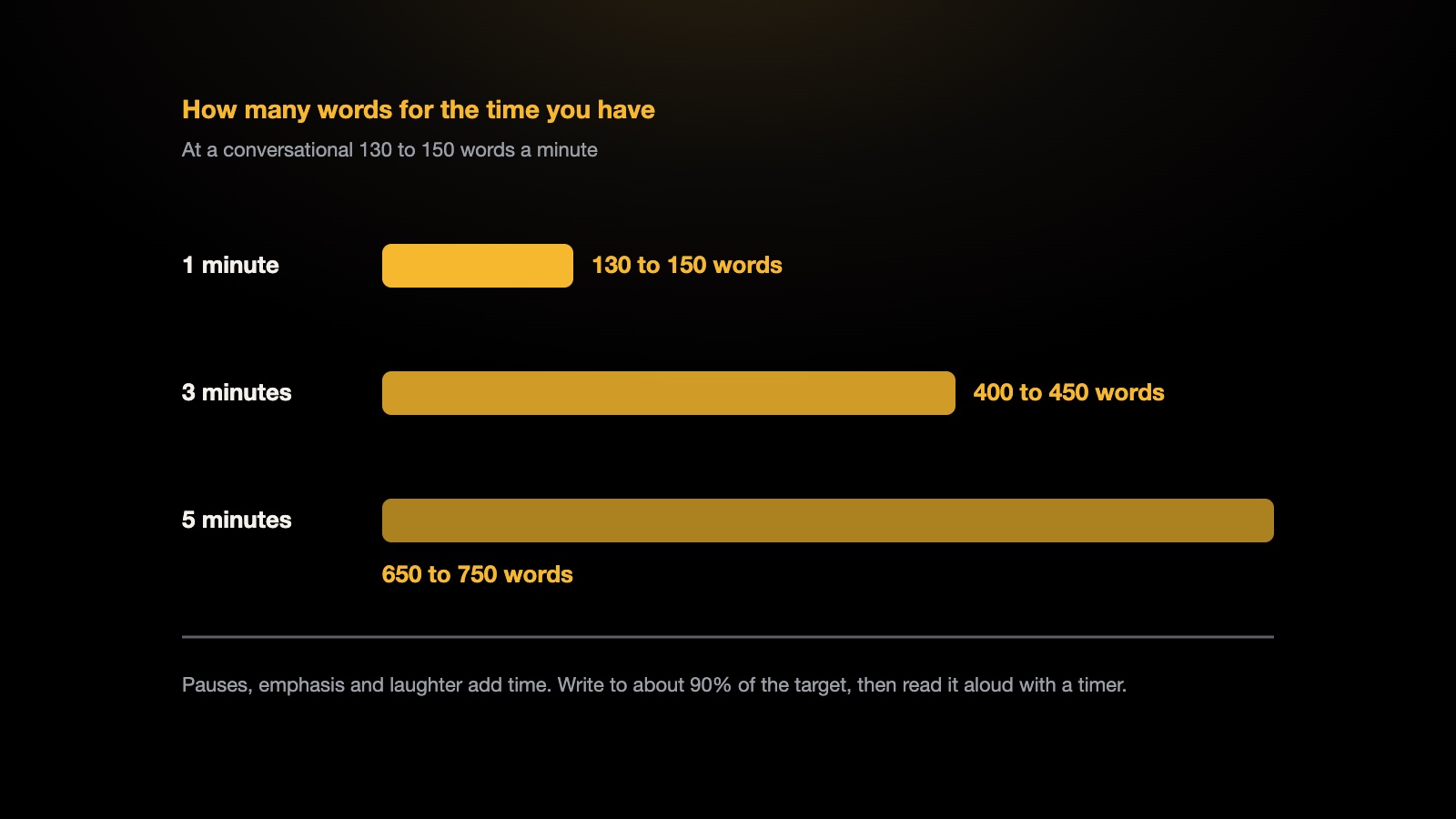
A 1 minute script is about 130 to 150 words. A 3 minute script is about 400 to 450. A 5 minute script is about 650 to 750. Those figures assume a relaxed, conversational pace. Yours may differ, and it is quick to find out by how much.
Words per minute, by pace
Most people speak somewhere between 110 and 170 words a minute. Slower suits a formal speech or a nervous read. Faster suits an energetic video, but it leaves less room for the audience to take things in.
| Pace | Words a minute | 1 minute | 3 minutes | 5 minutes |
|---|---|---|---|---|
| Slow | 110 to 125 | 110 to 125 | 330 to 375 | 550 to 625 |
| Conversational | 130 to 150 | 130 to 150 | 390 to 450 | 650 to 750 |
| Fast | 160 to 170 | 160 to 170 | 480 to 510 | 800 to 850 |
If you do not know your pace, use the conversational row and then measure yourself, as below. TeleprompterThis uses the same middle figure: its time estimates assume 150 words a minute at normal speed.
Measure your own rate in 60 seconds
You need a paragraph of at least 200 words, a timer and a way to count words. Any word processor shows a count when you select text.
- Pick a paragraph written the way you talk. Do not use a news article; the sentences are too dense.
- Start the timer and read aloud at the pace you would use for the real thing. Do not rush, and do not read it as a test.
- Stop at exactly 60 seconds. Mark the last word you said.
- Count the words from the start up to the mark. That number is your words a minute.
A worked example. You read a 220 word paragraph. At 60 seconds you are at the end of the sentence that finishes on word 138. Your rate is 138 words a minute. A 3 minute script is then 138 × 3 = 414 words, and a 5 minute script is 138 × 5 = 690.
Do it twice, once reading a script you have never seen and once reading something you have rehearsed. The second is usually a little faster. Use the average, and if the two are far apart, trust the slower one.
What adds time that a word count misses
A word count is the time with no stopping. A real read has stops in it.
- Pauses. A half-second pause after each key point is easy to forget. Ten of them add five seconds, and a script with deliberate pauses has many more.
- Emphasis. Stressing a word or slowing down for a stretch takes longer than saying the same words flat.
- Breaths. Long sentences need them, and so does a nervous speaker.
- The audience. Laughter, nods and a moment to take in a slide all take time. If you will speak live, the room sets some of the clock.
The practical rule: write to about 90 percent of the target. For a 3 minute slot at 140 words a minute, that is around 380 words rather than 420.
Put the pauses in the script
It is easier to budget for pauses when you can see them. In TeleprompterThis, [PAUSE] shows a clear marker where you stop, and a slash marks a quick breath. [SLOW] and [NORMAL] bracket a stretch to say a little more slowly. Our guide to writing a script for a teleprompter covers all of the cues.
The app estimates time from the words, not the pauses, so treat its figure as the shortest your script can be. Read it aloud once against a timer and use your real time.
Add time checks for a longer talk
For anything over a couple of minutes, mark where you should be and when. Put [@2:30] on its own line at the point you expect to reach after two minutes thirty. If you reach it early or late, you know whether to slow down or skip an example. This is the same idea as a speaker glancing at a clock, without the glance.
# Opening
Hello, and thank you for having me. / I want to give you one idea today.
[@0:30]
# The idea
[PAUSE]
...
[@2:30]
# Close
Fitting a script to a slot
- Choose your pace from the table, or measure it.
- Multiply the minutes you have by that pace, then take away about 10 percent.
- Write to that count. Check it with a word counter.
- Read it aloud against a timer. If it runs long, cut the least important section instead of reading faster.
- If you use voice follow, you set the pace as you speak, so the timer is a guide rather than a limit. See how voice-following teleprompters work.
For delivery once the length is right, see how to read a teleprompter without sounding robotic. In a hurry? 17 quick teleprompter tips fits on one screen.
Frequently asked questions
How many words is a 1 minute script?
About 130 to 150 words at a conversational pace. A slow, careful reader may fit 110 to 125, and a fast one 160 to 170. Measure your own rate before you commit to a number.
How many words is a 3 minute script?
About 400 to 450 words at a conversational pace. Plan for 330 to 375 if you speak slowly or plan to pause a lot, and up to 500 if you speak quickly.
How many words is a 5 minute script?
About 650 to 750 words at a conversational pace. Leave room for pauses and for the audience: a talk with laughter or questions needs fewer words, not more.
Why does my script run longer than my word count says?
Word counts assume you speak without stopping. Pauses, stressed words, breaths, slowing down for a key point and the audience reacting all add time. Cut the script to about 90 percent of the target and read it aloud against a timer.